The MAINRID Group of companies supplies certified equipment for conducting wind measuring campaigns. The range includes modern and reliable solutions from the world's leading manufacturers — Thies Clima, NRG Systems, Ammonit and Campbell Scientific, widely used in the assessment of wind potential and the implementation of projects in the field of wind energy.
The MAINRID Group of companies supplies certified equipment for conducting wind measuring campaigns. The range includes modern and reliable solutions from the world's leading manufacturers — Thies Clima, NRG Systems, Ammonit and Campbell Scientific, widely used in the assessment of wind potential and the implementation of projects in the field of wind energy.
The MAINRID Group of companies supplies certified equipment for conducting wind measuring campaigns. The range includes modern and reliable solutions from the world's leading manufacturers — Thies Clima, NRG Systems, Ammonit and Campbell Scientific, widely used in the assessment of wind potential and the implementation of projects in the field of wind energy.
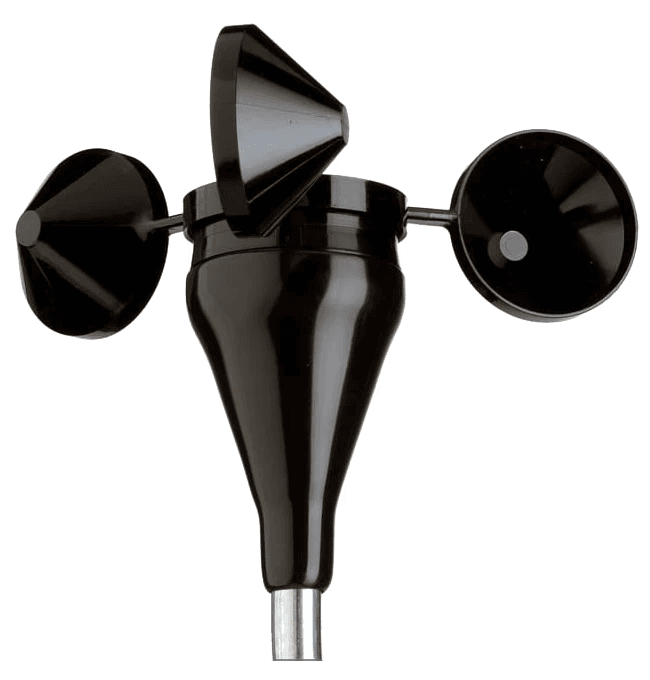
NRG 40C Anemometer
NRG 40C Anemometer
NRG 40C Anemometer
The 40C anemometer was one of the first anemometers designed specifically for the wind power industry. Their bearings and low moment of inertia make it possible to react very quickly to gusts of wind and lull. Due to the linearity of the output data, these sensors are ideally suited for use with various data retrieval systems. A four-pole magnet induces a sinusoidal voltage in the coil, generating an output signal with a frequency proportional to the wind speed.
Sensor measuring range from 1 m/s to 96 m/s;
Operating temperature range: -55 °C to 60 °C;
Operating humidity range: from 0 to 100%;
Weight: 0.14 kg;
Dimensions: 3 conical cups, diameter 51 mm, total height 81 mm.
The 40C anemometer was one of the first anemometers designed specifically for the wind power industry. Their bearings and low moment of inertia make it possible to react very quickly to gusts of wind and lull. Due to the linearity of the output data, these sensors are ideally suited for use with various data retrieval systems. A four-pole magnet induces a sinusoidal voltage in the coil, generating an output signal with a frequency proportional to the wind speed.
Sensor measuring range from 1 m/s to 96 m/s;
Operating temperature range: -55 °C to 60 °C;
Operating humidity range: from 0 to 100%;
Weight: 0.14 kg;
Dimensions: 3 conical cups, diameter 51 mm, total height 81 mm.
The 40C anemometer was one of the first anemometers designed specifically for the wind power industry. Their bearings and low moment of inertia make it possible to react very quickly to gusts of wind and lull. Due to the linearity of the output data, these sensors are ideally suited for use with various data retrieval systems. A four-pole magnet induces a sinusoidal voltage in the coil, generating an output signal with a frequency proportional to the wind speed.
Sensor measuring range from 1 m/s to 96 m/s;
Operating temperature range: -55 °C to 60 °C;
Operating humidity range: from 0 to 100%;
Weight: 0.14 kg;
Dimensions: 3 conical cups, diameter 51 mm, total height 81 mm.
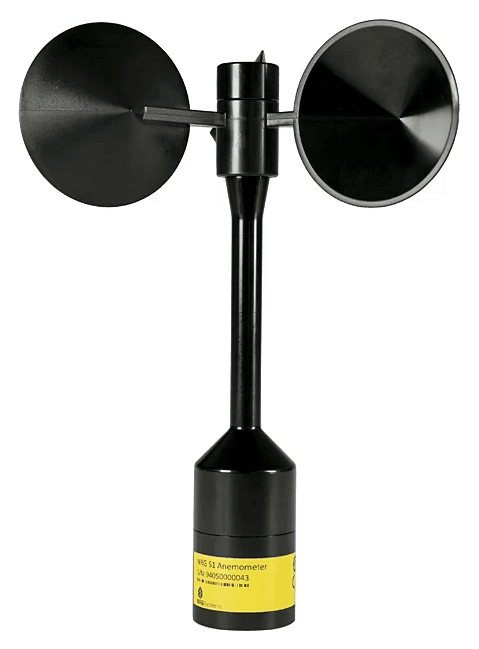
NRG S1 Anemometer
NRG S1 Anemometer
NRG S1 Anemometer
The NRG S1 anemometer provides a unique balance of high accuracy and low cost, making it ideal for reducing measurement errors during solar resource assessment campaigns as well as monitoring facilities. The proven bearing system and robust metal housing design ensure reliable sensor operation for many years in a variety of environmental conditions.
The NRG S1 anemometer is the only wind energy anemometer conforming to both editions of the IEC 61400-12-1 standard, which makes it easy to compare it with both new and outdated anemometers.
Sensor measuring range from 0.6 m/s to 75 m/s;
Operating temperature range: -30 °C to 60 °C;
Operating humidity range: from 0 to 100%;
Weight: 0.19 kg;
Dimensions: 3 conical cups, diameter 51 mm, total height 203 mm.
The NRG S1 anemometer provides a unique balance of high accuracy and low cost, making it ideal for reducing measurement errors during solar resource assessment campaigns as well as monitoring facilities. The proven bearing system and robust metal housing design ensure reliable sensor operation for many years in a variety of environmental conditions.
The NRG S1 anemometer is the only wind energy anemometer conforming to both editions of the IEC 61400-12-1 standard, which makes it easy to compare it with both new and outdated anemometers.
Sensor measuring range from 0.6 m/s to 75 m/s;
Operating temperature range: -30 °C to 60 °C;
Operating humidity range: from 0 to 100%;
Weight: 0.19 kg;
Dimensions: 3 conical cups, diameter 51 mm, total height 203 mm.
The NRG S1 anemometer provides a unique balance of high accuracy and low cost, making it ideal for reducing measurement errors during solar resource assessment campaigns as well as monitoring facilities. The proven bearing system and robust metal housing design ensure reliable sensor operation for many years in a variety of environmental conditions.
The NRG S1 anemometer is the only wind energy anemometer conforming to both editions of the IEC 61400-12-1 standard, which makes it easy to compare it with both new and outdated anemometers.
Sensor measuring range from 0.6 m/s to 75 m/s;
Operating temperature range: -30 °C to 60 °C;
Operating humidity range: from 0 to 100%;
Weight: 0.19 kg;
Dimensions: 3 conical cups, diameter 51 mm, total height 203 mm.
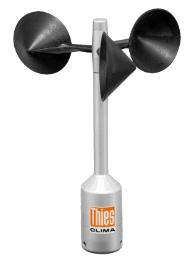
Thies First Class Anemometer
Thies First Class Anemometer
Thies First Class Anemometer
The Thies First class anemometer is designed to measure the horizontal component of wind speed in the field of meteorology and environmental measurement technology, location assessment, and power measurement of wind power systems. In flat terrain, the wind sensor meets all the requirements of the IEC 61400-12-1 standard for an instrument of accuracy class 0.5 (classification S).
Sensor measuring range from 0 m/s to 75 m/s;
Operating temperature range: -50 °C to 80 °C;
Weight: 0.5 kg;
Dimensions: 3 conical cups, diameter 80 mm, total height 290 mm.
The Thies First class anemometer is designed to measure the horizontal component of wind speed in the field of meteorology and environmental measurement technology, location assessment, and power measurement of wind power systems. In flat terrain, the wind sensor meets all the requirements of the IEC 61400-12-1 standard for an instrument of accuracy class 0.5 (classification S).
Sensor measuring range from 0 m/s to 75 m/s;
Operating temperature range: -50 °C to 80 °C;
Weight: 0.5 kg;
Dimensions: 3 conical cups, diameter 80 mm, total height 290 mm.
The Thies First class anemometer is designed to measure the horizontal component of wind speed in the field of meteorology and environmental measurement technology, location assessment, and power measurement of wind power systems. In flat terrain, the wind sensor meets all the requirements of the IEC 61400-12-1 standard for an instrument of accuracy class 0.5 (classification S).
Sensor measuring range from 0 m/s to 75 m/s;
Operating temperature range: -50 °C to 80 °C;
Weight: 0.5 kg;
Dimensions: 3 conical cups, diameter 80 mm, total height 290 mm.
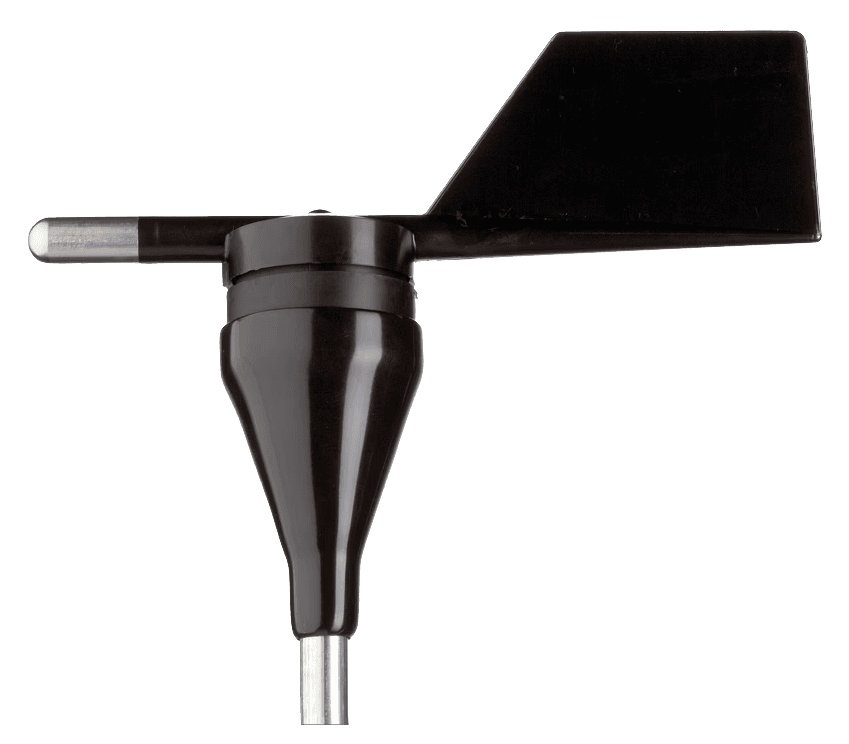
NRG 200M Wind Vane
NRG 200M Wind Vane
NRG 200M Wind Vane
NRG Systems’ 200M Wind Direction Vane brings significant upgrades to the proven design of our 200P Wind Direction Vane. Made from the same high-quality, UV-stabilized materials as the 200P, the 200M boasts 360° continuous measurement capability, lowering measurement uncertainty.
Improvements to the 200M’s sensing elementalso lower measurement uncertainty by improvingsensor accuracy.
The measuring range of the sensor is from 0° to 360°, at a speed of more than 90 m/s;
Operating temperature range: -40 °C to 60 °C;
Weight: 0.108 kg;
Dimensions: 21 cm in length and 12 cm in height.
NRG Systems’ 200M Wind Direction Vane brings significant upgrades to the proven design of our 200P Wind Direction Vane. Made from the same high-quality, UV-stabilized materials as the 200P, the 200M boasts 360° continuous measurement capability, lowering measurement uncertainty.
Improvements to the 200M’s sensing elementalso lower measurement uncertainty by improvingsensor accuracy.
The measuring range of the sensor is from 0° to 360°, at a speed of more than 90 m/s;
Operating temperature range: -40 °C to 60 °C;
Weight: 0.108 kg;
Dimensions: 21 cm in length and 12 cm in height.
NRG Systems’ 200M Wind Direction Vane brings significant upgrades to the proven design of our 200P Wind Direction Vane. Made from the same high-quality, UV-stabilized materials as the 200P, the 200M boasts 360° continuous measurement capability, lowering measurement uncertainty.
Improvements to the 200M’s sensing elementalso lower measurement uncertainty by improvingsensor accuracy.
The measuring range of the sensor is from 0° to 360°, at a speed of more than 90 m/s;
Operating temperature range: -40 °C to 60 °C;
Weight: 0.108 kg;
Dimensions: 21 cm in length and 12 cm in height.
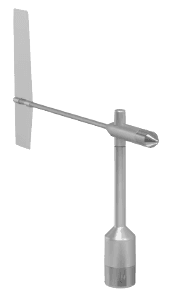
Thies First Class Wind Vane
Thies First Class Wind Vane
Thies First Class Wind Vane
The Thies First class vane is designed to determine the horizontal component of wind direction in the field of meteorology and environmental measurements, to assess the location and measure the power characteristics of wind power systems. The measured value is output as an analog signal. The output signal can be transmitted to indicators, recording devices, data loggers, as well as to process control systems.
Sensor measuring range from 0° to 360°, at speeds up to 75 m/s;
Operating temperature range: -50 °C to 80 °C;
Weight: 0.7 kg;
Dimensions: 45 cm in length and 41 cm in height, mounting diameter 35 mm.
The Thies First class vane is designed to determine the horizontal component of wind direction in the field of meteorology and environmental measurements, to assess the location and measure the power characteristics of wind power systems. The measured value is output as an analog signal. The output signal can be transmitted to indicators, recording devices, data loggers, as well as to process control systems.
Sensor measuring range from 0° to 360°, at speeds up to 75 m/s;
Operating temperature range: -50 °C to 80 °C;
Weight: 0.7 kg;
Dimensions: 45 cm in length and 41 cm in height, mounting diameter 35 mm.
The Thies First class vane is designed to determine the horizontal component of wind direction in the field of meteorology and environmental measurements, to assess the location and measure the power characteristics of wind power systems. The measured value is output as an analog signal. The output signal can be transmitted to indicators, recording devices, data loggers, as well as to process control systems.
Sensor measuring range from 0° to 360°, at speeds up to 75 m/s;
Operating temperature range: -50 °C to 80 °C;
Weight: 0.7 kg;
Dimensions: 45 cm in length and 41 cm in height, mounting diameter 35 mm.
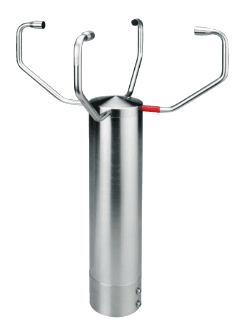
Thies Ultrasonic Anemometer
Thies Ultrasonic Anemometer
Thies Ultrasonic Anemometer
The 2D ultrasonic anemometer is designed for two-dimensional measurement of the horizontal components of wind speed and direction, as well as acoustic-virtual temperature. The ultrasonic measuring principle makes it possible, compared with classical anemometers, to measure variable dimensions in operation with the highest accuracy without inertia. It is particularly suitable for measuring gusty and peak values.
Sensor measuring range from 0° to 360°, wind speed from 0.01 to 85 m/s, temperature -50 °C to 70 °C;
Operating temperature range: -40 °C to 70 °C;
Weight: 2.5 kg;
Dimensions: 287 mm in length and 424 mm in height, mounting diameter 70 mm.
The 2D ultrasonic anemometer is designed for two-dimensional measurement of the horizontal components of wind speed and direction, as well as acoustic-virtual temperature. The ultrasonic measuring principle makes it possible, compared with classical anemometers, to measure variable dimensions in operation with the highest accuracy without inertia. It is particularly suitable for measuring gusty and peak values.
Sensor measuring range from 0° to 360°, wind speed from 0.01 to 85 m/s, temperature -50 °C to 70 °C;
Operating temperature range: -40 °C to 70 °C;
Weight: 2.5 kg;
Dimensions: 287 mm in length and 424 mm in height, mounting diameter 70 mm.
The 2D ultrasonic anemometer is designed for two-dimensional measurement of the horizontal components of wind speed and direction, as well as acoustic-virtual temperature. The ultrasonic measuring principle makes it possible, compared with classical anemometers, to measure variable dimensions in operation with the highest accuracy without inertia. It is particularly suitable for measuring gusty and peak values.
Sensor measuring range from 0° to 360°, wind speed from 0.01 to 85 m/s, temperature -50 °C to 70 °C;
Operating temperature range: -40 °C to 70 °C;
Weight: 2.5 kg;
Dimensions: 287 mm in length and 424 mm in height, mounting diameter 70 mm.
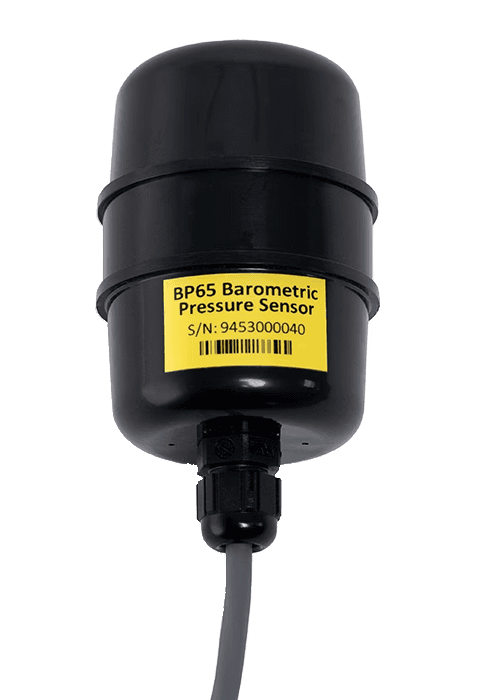
NRG BP60 Barometric pressure sensor
NRG BP60 Barometric pressure sensor
NRG BP60 Barometric pressure sensor
The NRG BP65 atmospheric pressure sensor is well suited for measuring atmospheric pressure in remote studies of wind and solar energy use, in particular, for calculating air density and annual energy production. Its robust housing protects the high-precision sensor element, ensuring reliable operation in various climatic conditions.
The BP65 retains the proven design of its predecessor, the BP60, ensuring a smooth transition to this next-generation sensor.
Sensor measuring range: from 500 gPa to 1100 gPa.
Weight: 0.12 kg;
Dimensions: diameter 55 mm, height 101 mm.
The NRG BP65 atmospheric pressure sensor is well suited for measuring atmospheric pressure in remote studies of wind and solar energy use, in particular, for calculating air density and annual energy production. Its robust housing protects the high-precision sensor element, ensuring reliable operation in various climatic conditions.
The BP65 retains the proven design of its predecessor, the BP60, ensuring a smooth transition to this next-generation sensor.
Sensor measuring range: from 500 gPa to 1100 gPa.
Weight: 0.12 kg;
Dimensions: diameter 55 mm, height 101 mm.
The NRG BP65 atmospheric pressure sensor is well suited for measuring atmospheric pressure in remote studies of wind and solar energy use, in particular, for calculating air density and annual energy production. Its robust housing protects the high-precision sensor element, ensuring reliable operation in various climatic conditions.
The BP65 retains the proven design of its predecessor, the BP60, ensuring a smooth transition to this next-generation sensor.
Sensor measuring range: from 500 gPa to 1100 gPa.
Weight: 0.12 kg;
Dimensions: diameter 55 mm, height 101 mm.
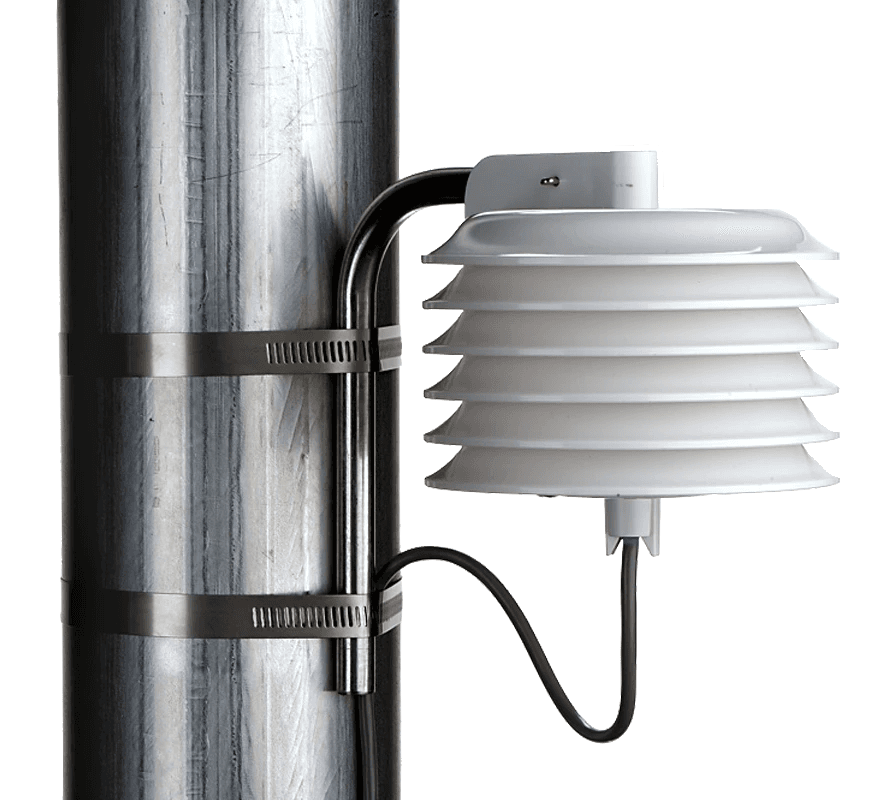
NRG T60 Temperature sensor
NRG T60 Temperature sensor
NRG T60 Temperature sensor
The NRG T60 temperature sensor is a new sensor element that complements the time-tested design of the NRG 110S. The result is a durable and reliable sensor that provides lower measurement error and is capable of performing measurements at higher temperatures. Since the T60 has the same physical design, output signal, and wiring diagram as the 110S, the transition to this next-generation sensor is exceptionally simple.
Sensor measuring range: -40 °C to 70 °C.
Weight: 0.47 kg;
Dimensions: diameter 12.7 mm, height 51.6 mm;
Screen dimensions: diameter 127 mm, height 124 mm.
The NRG T60 temperature sensor is a new sensor element that complements the time-tested design of the NRG 110S. The result is a durable and reliable sensor that provides lower measurement error and is capable of performing measurements at higher temperatures. Since the T60 has the same physical design, output signal, and wiring diagram as the 110S, the transition to this next-generation sensor is exceptionally simple.
Sensor measuring range: -40 °C to 70 °C.
Weight: 0.47 kg;
Dimensions: diameter 12.7 mm, height 51.6 mm;
Screen dimensions: diameter 127 mm, height 124 mm.
The NRG T60 temperature sensor is a new sensor element that complements the time-tested design of the NRG 110S. The result is a durable and reliable sensor that provides lower measurement error and is capable of performing measurements at higher temperatures. Since the T60 has the same physical design, output signal, and wiring diagram as the 110S, the transition to this next-generation sensor is exceptionally simple.
Sensor measuring range: -40 °C to 70 °C.
Weight: 0.47 kg;
Dimensions: diameter 12.7 mm, height 51.6 mm;
Screen dimensions: diameter 127 mm, height 124 mm.
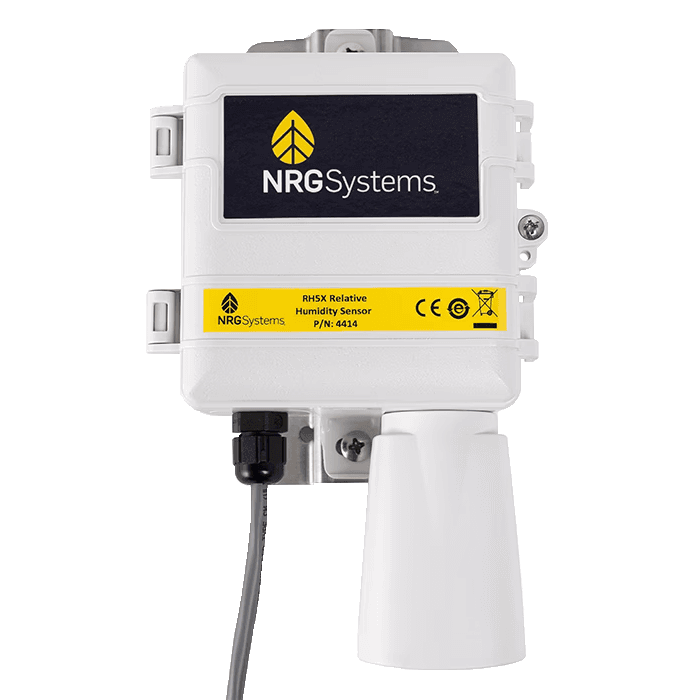
NRG RH5X Relative humidity sensor
NRG RH5X Relative humidity sensor
NRG RH5X Relative humidity sensor
The NRG RH5X sensor is compatible with a set of NRG data loggers, including the LOGR|Met data logger, LOGR|Solar data Logger, LOGR-S data logger, and SymphoniePRO data logger.
The RH5X sensor is equipped with a polymer resistive sensor that provides excellent linearity and sensitivity with fast response and long-term stability. It is attached to the bottom of the protective box and includes a 1.5m (5 in) long cable, a mounting bracket and one hose clamp.
Sensor measuring range: from 0% to 100%.
Weight: 0.32 kg;
Dimensions: diameter 12.7 mm, height 51.6 mm;
Screen size: 190x113x69 mm.
The NRG RH5X sensor is compatible with a set of NRG data loggers, including the LOGR|Met data logger, LOGR|Solar data Logger, LOGR-S data logger, and SymphoniePRO data logger.
The RH5X sensor is equipped with a polymer resistive sensor that provides excellent linearity and sensitivity with fast response and long-term stability. It is attached to the bottom of the protective box and includes a 1.5m (5 in) long cable, a mounting bracket and one hose clamp.
Sensor measuring range: from 0% to 100%.
Weight: 0.32 kg;
Dimensions: diameter 12.7 mm, height 51.6 mm;
Screen size: 190x113x69 mm.
The NRG RH5X sensor is compatible with a set of NRG data loggers, including the LOGR|Met data logger, LOGR|Solar data Logger, LOGR-S data logger, and SymphoniePRO data logger.
The RH5X sensor is equipped with a polymer resistive sensor that provides excellent linearity and sensitivity with fast response and long-term stability. It is attached to the bottom of the protective box and includes a 1.5m (5 in) long cable, a mounting bracket and one hose clamp.
Sensor measuring range: from 0% to 100%.
Weight: 0.32 kg;
Dimensions: diameter 12.7 mm, height 51.6 mm;
Screen size: 190x113x69 mm.
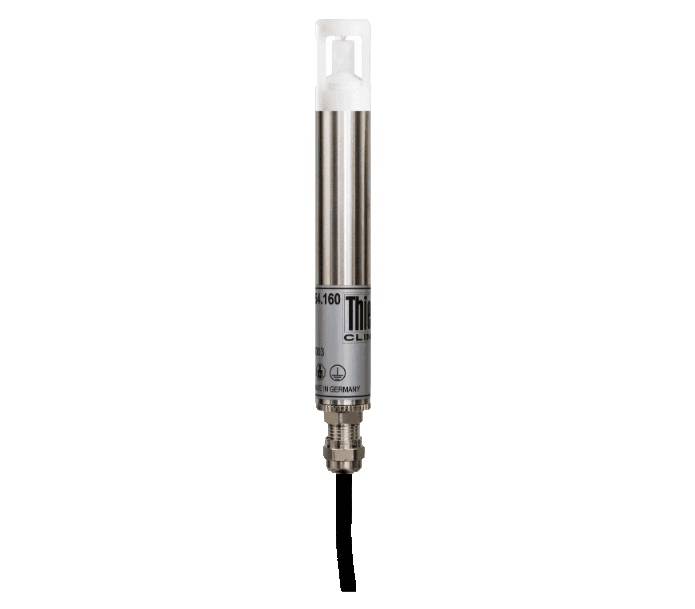
Thies Hygro-Thermo-Baro transmitter
Thies Hygro-Thermo-Baro transmitter
Thies Hygro-Thermo-Baro transmitter
The device is designed to measure air temperature and humidity.
The data is output as electrical analog signals. The sensors consist of a capacitive humidity sensor and a Pt 100 resistance thermometer. For outdoor installation, it is recommended to use protection from atmospheric influences and thermal radiation.
Sensor measuring range: from 0% to 100% relative humidity; -40 °C to 85 °C; from 300 hPa to 1200 hPa.
Weight: 0.45 kg;
Dimensions: diameter 20 mm, height 166-200 mm, depending on the model.
The device is designed to measure air temperature and humidity.
The data is output as electrical analog signals. The sensors consist of a capacitive humidity sensor and a Pt 100 resistance thermometer. For outdoor installation, it is recommended to use protection from atmospheric influences and thermal radiation.
Sensor measuring range: from 0% to 100% relative humidity; -40 °C to 85 °C; from 300 hPa to 1200 hPa.
Weight: 0.45 kg;
Dimensions: diameter 20 mm, height 166-200 mm, depending on the model.
The device is designed to measure air temperature and humidity.
The data is output as electrical analog signals. The sensors consist of a capacitive humidity sensor and a Pt 100 resistance thermometer. For outdoor installation, it is recommended to use protection from atmospheric influences and thermal radiation.
Sensor measuring range: from 0% to 100% relative humidity; -40 °C to 85 °C; from 300 hPa to 1200 hPa.
Weight: 0.45 kg;
Dimensions: diameter 20 mm, height 166-200 mm, depending on the model.
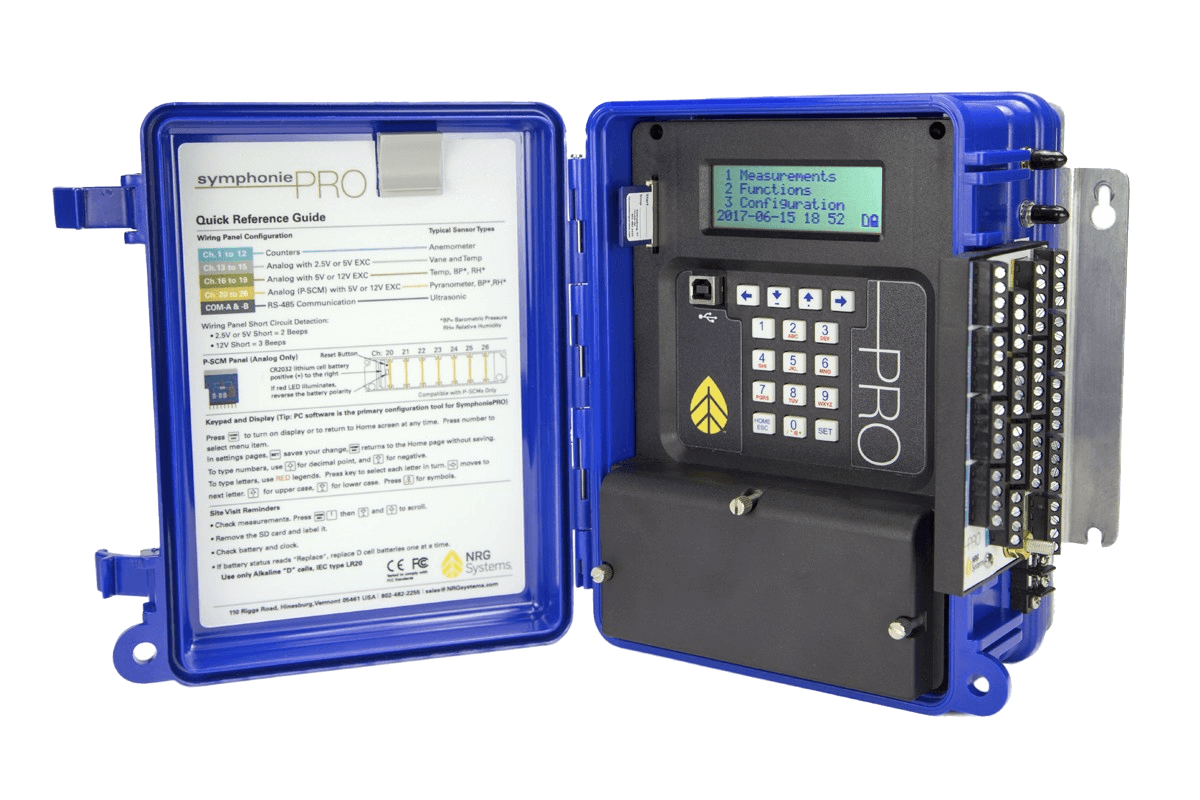
SymphoniePRO Data Logger
SymphoniePRO Data Logger
SymphoniePRO Data Logger
SymphoniePRO is an industrial low-power data logging system specifically designed for resource assessment in the renewable energy industry. If necessary, the measuring power of the recorder can be optimized using 26-channel or 16-channel mounting panels. The statistical values of each channel are calculated based on continuous 1-second data samples and averaged over a user-selectable interval (10 minutes by default). The collected data is effectively stored as binary *.RLD files in an internal flash memory with a backup on an external SD card, if installed.
Recorder dimensions: 22.2 cm x 18.7 cm x 7.4cm
Connection Panel dimensions: 30 cm x 12 cm x 5 cm
Weight: 1.3 kg
SymphoniePRO is an industrial low-power data logging system specifically designed for resource assessment in the renewable energy industry. If necessary, the measuring power of the recorder can be optimized using 26-channel or 16-channel mounting panels. The statistical values of each channel are calculated based on continuous 1-second data samples and averaged over a user-selectable interval (10 minutes by default). The collected data is effectively stored as binary *.RLD files in an internal flash memory with a backup on an external SD card, if installed.
Recorder dimensions: 22.2 cm x 18.7 cm x 7.4cm
Connection Panel dimensions: 30 cm x 12 cm x 5 cm
Weight: 1.3 kg
SymphoniePRO is an industrial low-power data logging system specifically designed for resource assessment in the renewable energy industry. If necessary, the measuring power of the recorder can be optimized using 26-channel or 16-channel mounting panels. The statistical values of each channel are calculated based on continuous 1-second data samples and averaged over a user-selectable interval (10 minutes by default). The collected data is effectively stored as binary *.RLD files in an internal flash memory with a backup on an external SD card, if installed.
Recorder dimensions: 22.2 cm x 18.7 cm x 7.4cm
Connection Panel dimensions: 30 cm x 12 cm x 5 cm
Weight: 1.3 kg
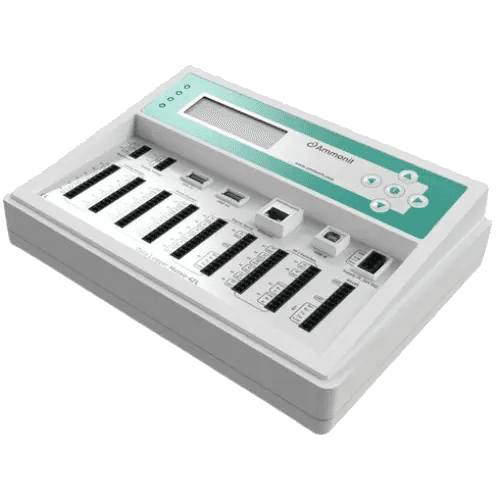
Ammonit Meteo-42 Data Logger
The Meteo-42 is easy to set up – in your office or directly on site – using the same communication tools and software as the Meteo-40 plus: AmmonitConnect and AmmonitOR cloud. Our data loggers are easy to install and work reliably worldwide.
The Meteo-42 offers these technical innovations:
• Three RS-485 ports
• Faster processors
• Improved grounding for more accurate measurement of analog values
• More flexible switches
Recorder dimensions: 260 × 194 × 67 mm
Weight: 1.1 kg
Ammonit Meteo-42 Data Logger
The Meteo-42 is easy to set up – in your office or directly on site – using the same communication tools and software as the Meteo-40 plus: AmmonitConnect and AmmonitOR cloud. Our data loggers are easy to install and work reliably worldwide.
The Meteo-42 offers these technical innovations:
• Three RS-485 ports
• Faster processors
• Improved grounding for more accurate measurement of analog values
• More flexible switches
Recorder dimensions: 260 × 194 × 67 mm
Weight: 1.1 kg
Ammonit Meteo-42 Data Logger
The Meteo-42 is easy to set up – in your office or directly on site – using the same communication tools and software as the Meteo-40 plus: AmmonitConnect and AmmonitOR cloud. Our data loggers are easy to install and work reliably worldwide.
The Meteo-42 offers these technical innovations:
• Three RS-485 ports
• Faster processors
• Improved grounding for more accurate measurement of analog values
• More flexible switches
Recorder dimensions: 260 × 194 × 67 mm
Weight: 1.1 kg
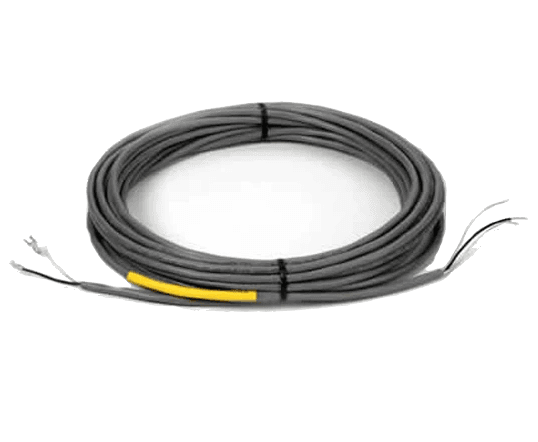
Cable products for connecting meteorological equipment are selected individually. The number of cores, the conductor cross-section and the total length of the cable are determined by the configuration of the measuring sensors, the wiring diagram, the power supply and signal transmission requirements.
Cable products for connecting meteorological equipment are selected individually. The number of cores, the conductor cross-section and the total length of the cable are determined by the configuration of the measuring sensors, the wiring diagram, the power supply and signal transmission requirements.
Cable products for connecting meteorological equipment are selected individually. The number of cores, the conductor cross-section and the total length of the cable are determined by the configuration of the measuring sensors, the wiring diagram, the power supply and signal transmission requirements.
Contact us
We will answer all your questions
